Alexander the Great by James Romm
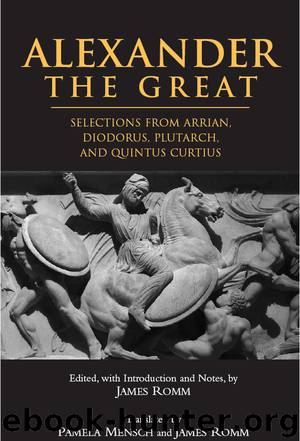
Author:James Romm
Language: eng
Format: epub
Tags: ebook, book
Publisher: Hackett Publishing Company, Inc.
Published: 2013-02-01T16:00:00+00:00
VI
The Central Asian
Campaigns
(Summer 330–Spring 327 B.C.E.)
a. The Philotas affair and the killing of Parmenio
With the death of Darius, Alexander could legitimately claim rulership of all the lands that comprised the former Persian empire, and he might well have ended his campaign then and there. But such a resolution did not square with the king’s restless and indomitable nature. He immediately undertook a quest to capture the murderers of Darius, chief among them Bessus of Bactria, who had assumed the title and insignia of the Persian king and had fled into the hinterlands to organize an anti-Macedonian resistance. The hunt for Bessus took Alexander into the rugged, dry, inhospitable northeastern quadrant of the Persian realm, the provinces of Drangiana and Areia (making up parts of today’s Afghanistan and Iran). The landscape was harsher here than what the Macedonians had met with thus far, and the local politics more treacherous: twice in the year 330 the Persian satraps appointed by Alexander to govern this region revolted against him. Both rebellions were successfully put down but only at considerable cost to the morale of the army and the pace of the pursuit of Bessus. Small wonder that, in the midst of this parched and unfriendly environment, tensions began to build among the troops, leading to the first of a series of conspiracy trials in the autumn of 330: the so-called Philotas affair.
Philotas was the last surviving son of Parmenio, the great senior general who had served first as Philip’s and then Alexander’s second in command. Philotas, unlike his father, was not well-liked by his countrymen, and thus far in the campaign he had not received any significant commands, though due to his lineage he was of course included among the Companions who made up Alexander’s inner circle. Because he had direct access to the king, a lower-ranking Macedonian named Cebalinus came to him one day and reported that a fellow soldier, Dymnus, had invited him to join a conspiracy against Alexander’s life. Cebalinus intended that the report be passed on by Philotas to Alexander, but, for whatever reason, Philotas said nothing. A few days later Cebalinus anxiously brought the plot to someone else’s attention, and Alexander was thereby informed; Dymnus was summoned for questioning but promptly wounded himself so severely with his sword that nothing could be learned from him.
Suspicion of involvement now fell on Philotas, who had failed to pass on Cebalinus’ information at the first opportunity. (Evidently it was not the first time Alexander had questioned the loyalty of this natural rival: some sources claim that Philotas’ Greek courtesan had been recruited as an informant during the sojourn in Egypt two years earlier.) Some sort of trial was held, though the outcome was hardly in doubt, and Philotas was also apparently interrogated under torture (though Arrian is silent on this point) and made to admit some role in the plot, as well as to implicate his father, Parmenio. He was summarily executed along with a number of other perceived enemies of
Download
This site does not store any files on its server. We only index and link to content provided by other sites. Please contact the content providers to delete copyright contents if any and email us, we'll remove relevant links or contents immediately.
The Vikings: Conquering England, France, and Ireland by Wernick Robert(84669)
Ali Pasha, Lion of Ioannina by Eugenia Russell & Eugenia Russell(40416)
The Conquerors (The Winning of America Series Book 3) by Eckert Allan W(39524)
The Vikings: Discoverers of a New World by Wernick Robert(37057)
Cecilia; Or, Memoirs of an Heiress — Volume 1 by Fanny Burney(32752)
Cecilia; Or, Memoirs of an Heiress — Volume 2 by Fanny Burney(32113)
Cecilia; Or, Memoirs of an Heiress — Volume 3 by Fanny Burney(32094)
Empire of the Sikhs by Patwant Singh(23225)
The Secret History by Donna Tartt(19516)
Hans Sturm: A Soldier's Odyssey on the Eastern Front by Gordon Williamson(18738)
Cat's cradle by Kurt Vonnegut(15589)
Pimp by Iceberg Slim(14823)
Sapiens: A Brief History of Humankind by Yuval Noah Harari(14589)
Norse Mythology by Gaiman Neil(13678)
Talking to Strangers by Malcolm Gladwell(13579)
Leonardo da Vinci by Walter Isaacson(13548)
4 3 2 1: A Novel by Paul Auster(12645)
Underground: A Human History of the Worlds Beneath Our Feet by Will Hunt(12265)
The Radium Girls by Kate Moore(12224)
